We often talk about the “Valley of Death” in biotech—the dangerous funding gap between a promising scientific discovery and the capital needed to turn that discovery into a viable product. This is where promising therapies can stall, companies can fail, and potentially life-saving innovations can disappear before they ever reach patients.
But there is another Valley of Death that receives far less attention.
It happens after a technology has been developed, validated, and, in many cases, cleared or approved for use—but still fails to reach the people who need it.
Across cancer care, innovative diagnostics, clinical tools, and precision medicine technologies are being developed to help oncologists make better decisions, monitor disease, identify recurrence, and personalize treatment. Yet many of these tools struggle to gain adoption. The developers may lack the resources to effectively communicate with patient communities. They may not have the marketing reach to educate clinicians. And they may not have the relationships or infrastructure needed to help healthcare providers become familiar enough with a new technology to incorporate it into clinical practice.
The result is a frustrating paradox: Innovation exists, but access does not.
Patients may never hear about technologies that could help inform their care. Oncologists may not be aware of tools that could provide additional insights into treatment decisions. And developers may struggle to bridge the gap between having a clinically meaningful technology and having that technology become part of everyday cancer care.
At Music Beats Cancer, we believe this is a problem we can—and must—help solve.
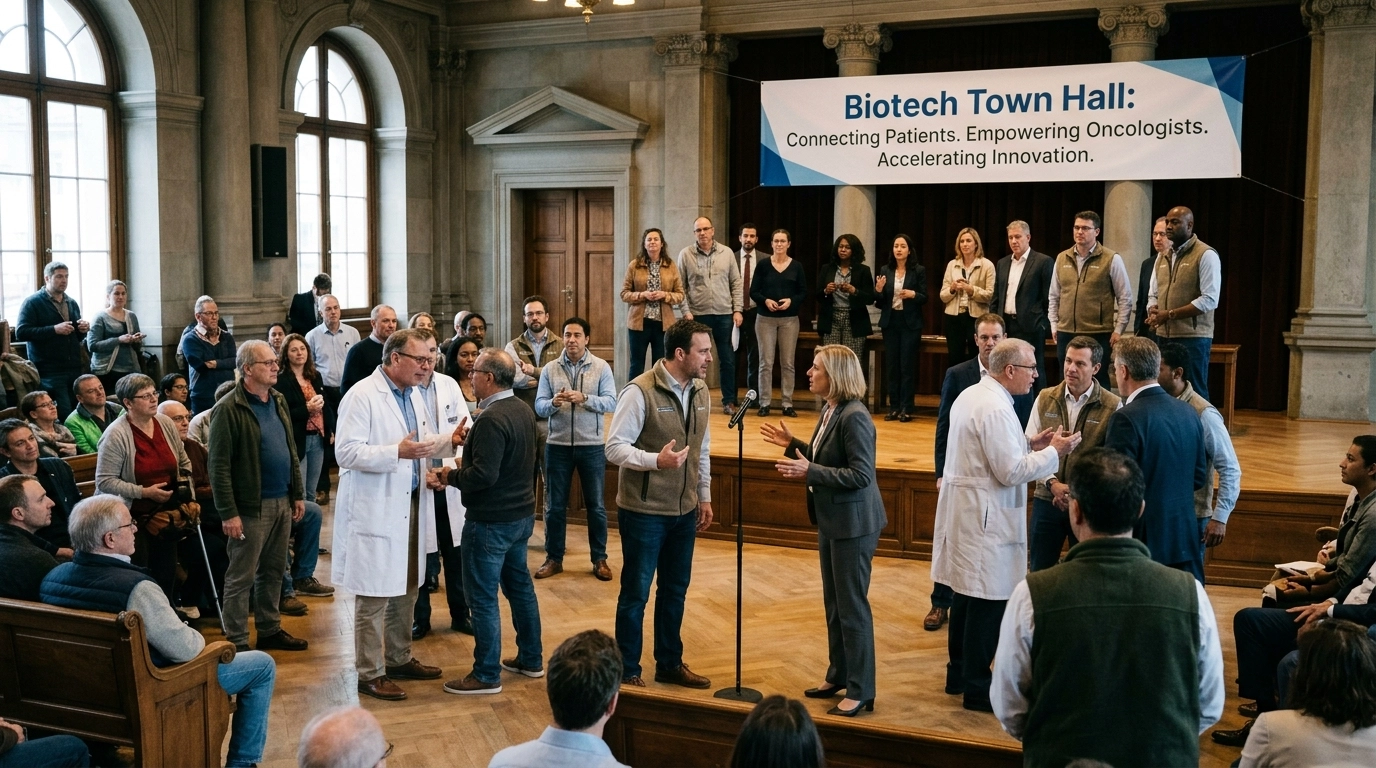
That’s why we are launching “Biotech Town Hall,” a livestream designed to bring together the people who are at the center of this challenge: patients, caregivers, oncologists, healthcare providers, and biotech innovators.
The goal is simple: to create a forum where promising clinical tools and technologies can be explained, discussed, and understood from multiple perspectives.
Patients deserve to know what tools are available to help them make informed decisions about their care. Clinicians need access to clear, credible information about innovations that may help them better treat their patients. And biotech companies need a platform to communicate directly with the communities they are working so hard to serve.
We will partner with relevant patient advocacy organizations and communities to ensure that these conversations are grounded in the real experiences and needs of patients. We will bring developers to the table to explain how their technologies work and what problems they are designed to solve. And we will invite providers to help us understand how these tools can be integrated into clinical practice.
In other words, Biotech Town Hall will connect the developer, the provider, and the patient.
Our first company to be featured is CureMatch, a precision medicine company addressing one of the most fundamental challenges in cancer care: no two patients are genetically identical, and therefore, the same treatment may not work the same way for every person.
CureMatch has developed a precision medicine platform designed to help oncologists analyze a patient’s unique genomic information and identify and rank potential targeted treatment options and drug combinations that may be appropriate for consideration. By leveraging proprietary algorithms alongside genomic, clinical, and historical data, the platform provides oncologists with predictive treatment analysis intended to deliver actionable insights tailored to each individual patient’s case.
This is the promise of precision medicine: moving away from a one-size-fits-all approach and toward treatment decisions that account for the biology of the individual patient.
CureMatch reports that patients treated with combination therapies selected based on high matching scores experienced significantly improved progression-free survival in 75% of patients in its cited analysis.* Whether it is a precision medicine platform like CureMatch, a new diagnostic, a tool to monitor recurrence, or another clinical technology, the larger question is the same:
How do we make sure that innovations designed to help patients actually reach them?
The answer cannot rest entirely on biotech companies. Most emerging companies are built around scientific expertise, not marketing infrastructure. Their resources are focused on research, development, regulatory requirements, clinical validation, and commercialization. Expecting every innovative company to simultaneously build the infrastructure required to educate millions of patients and thousands of healthcare providers is unrealistic.
And yet, without that education and awareness, adoption can remain painfully slow.
This is why we believe the ecosystem itself must play a role.
Patient communities are powerful. They are trusted sources of information and advocacy for people navigating some of the most difficult moments of their lives. Healthcare providers are equally essential, because they are the bridge between innovation and clinical practice. Biotech companies bring the technology and scientific expertise. By bringing these groups together, we can begin to close the gap between innovation and access.
Biotech Town Hall is our attempt to build that bridge.
At Music Beats Cancer, we have spent years addressing the funding Valley of Death that prevents promising cancer innovations from advancing. We now see another opportunity to make an impact: helping innovations that already exist reach the communities they were designed to serve.
We believe that every patient should have the opportunity to understand what technologies and tools may be available to support their care. We believe every clinician should have access to the information needed to evaluate emerging technologies. And we believe biotech innovators deserve a meaningful opportunity to engage directly with the people whose lives they are trying to improve.
The cancer innovation ecosystem doesn’t just need more breakthroughs.
It needs better pathways for those breakthroughs to reach people.
That is why we are launching Biotech Town Hall.
Because when a patient, a provider, and an innovator sit at the same table, we don’t just have a conversation.
We create a pathway to access.